




Jassim al Tarshi
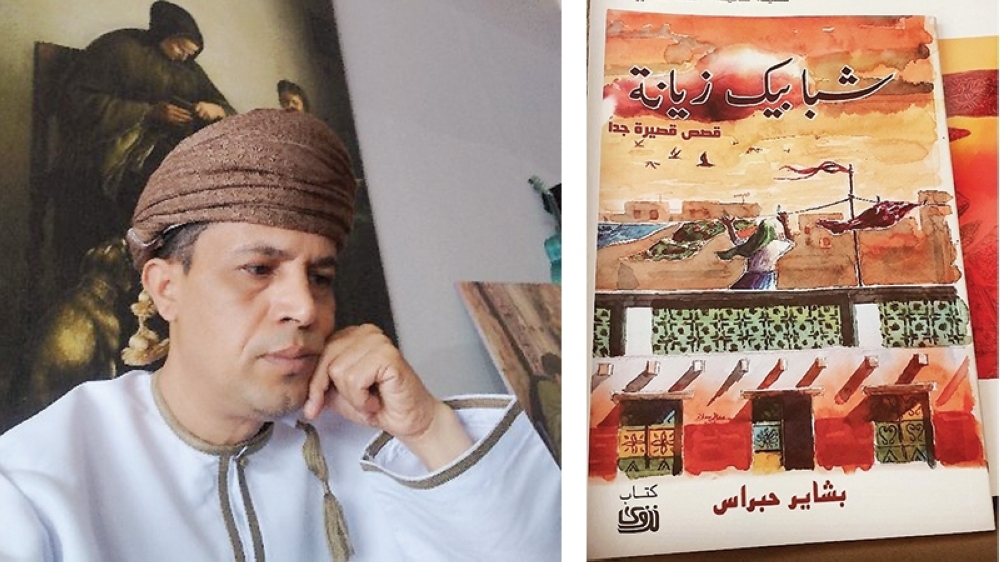
A close reading of Zayana’s Windows, a collection of very short stories by Omani writer Bashayer Hibras, reveals a striking feature running through much of the book: the blending of narrative with the visual arts.
Published by Nizwa Book in 2020, the collection frequently draws on photography, painting, drawing, sculpture and decoration. The boundaries between storytelling and visual expression become fluid, allowing images and objects to participate in creating meaning rather than merely decorating the narrative.
Photography has the strongest presence. Nine stories employ photographs as essential parts of their structure, including The Photograph, Layla’s Bedside Table, A Boy in the Frame, My Father’s Shoulder, and The Nail. Visual art appears in seven other stories through drawing, sculpture and decorative forms.
This interaction between word and image often provides the starting point for the story itself. In Layla’s Bedside Table, for example, the narrative begins with a photograph:
“In the photograph on the bedside table, Layla is swimming in the sea. Half the picture is sky, the other half water, with Layla’s head alone in the middle.”
A similarly unusual opening appears in A Boy in the Frame, where a photograph becomes strangely alive:
“A crying boy is trapped inside a frame hanging on the living-room wall. His mother wipes the picture morning and evening, always noticing that it remains wet.”
The power of the scene comes from the contradiction between stillness and movement. A photograph is supposed to be motionless, yet the child continues to cry and the picture remains wet. This visual paradox unsettles expectations and invites the reader to search for meanings beneath the surface.
Such paradoxes are particularly effective in very short fiction, where the ending often carries much of the story’s force. In The Photograph, a widow repeatedly looks at a picture of her dead husband. When she stands before it wearing a short crimson nightdress, she imagines him smiling and raising his eyebrows. Later, dressed conservatively before leaving for work, she discovers that the photograph has turned its face towards the wall.
The visual image therefore becomes the story’s final surprise.
The same technique appears beautifully in The Nail. The father always refuses to join family photographs, saying simply: “I am the nail.”
Then he dies:
“And all the photographs fell from the walls.”
The image turns the father’s metaphor into reality. Like the nail holding photographs in place, he had been the unseen support holding the family together. Once he disappears, the family’s shared happiness symbolically collapses with him.
Visual art performs a similar role in Drowning. A household appears to be facing a catastrophic flood: lunch is drowning, the kitchen is drowning, the house is drowning, everyone is drowning. The final sentence reveals that the domestic worker has flooded the house because of a plate shaped like a fish. The absurdly small cause behind the apparent disaster creates the comic shock on which the story depends.
This reliance on visual imagery also helps Hibras achieve one of the most important requirements of very short fiction: compression. Instead of relying on elaborate poetic language, a single photograph, drawing or sculpted object can suggest an entire emotional world.
The visual arts also open the stories towards dream and surrealism. In The Short One and the Tall Woman, sculpture becomes a way of correcting reality. The narrator recalls being too short to lift a bride’s veil and later creating a tall figure, only to realise that her imagination was still shaped by practical concerns such as reaching dishes on the highest kitchen shelves.
In A Girl Made of Paper, drawing provides another form of escape. A girl imagines a bathtub, a shower and another girl her own size bathing on the page. Art allows a desired world to exist where reality cannot provide it.
Perhaps one of the clearest examples is Jelah, an Omani colloquial word referring to a beardless man. A boy, embarrassed because his father has no beard like the fathers of his schoolmates, secretly draws a moustache and beard on his sleeping father’s face. He also draws long earrings on his mother after his father refuses to buy her any. The next morning, the drawings seem mysteriously to have entered reality: his mother appears delighted with her earrings, while traces of shaved hair and a razor suggest that the father’s painted beard somehow became real.
Here, drawing is no longer simply representation. It becomes a means of changing reality.
This blending of the narrative and the visual is one of the defining strengths of Zayana’s Windows. Photographs, drawings, sculptures and objects give the stories remarkable economy, allowing Hibras to reduce conventional description while expanding symbolic meaning.
The visual elements also give the stories a cinematic quality, transforming static details into scenes filled with movement, surprise and ambiguity.
In her first experiment with very short fiction, Bashayer Hibras therefore creates a distinctive narrative language in which words and images constantly interact. The result is a collection whose humour, surrealism and emotional force often emerge precisely from the moment when storytelling crosses into the visual arts.
Jassim al Tarshi is an Omani writer
Translated and adapted by Badr al Dhafari
This is an adapted translation of the original Arabic article published in the print edition of the cultural supplement of the Oman Daily newspaper on 26 August, 2026.
Oman Observer is now on the WhatsApp channel. Click here